

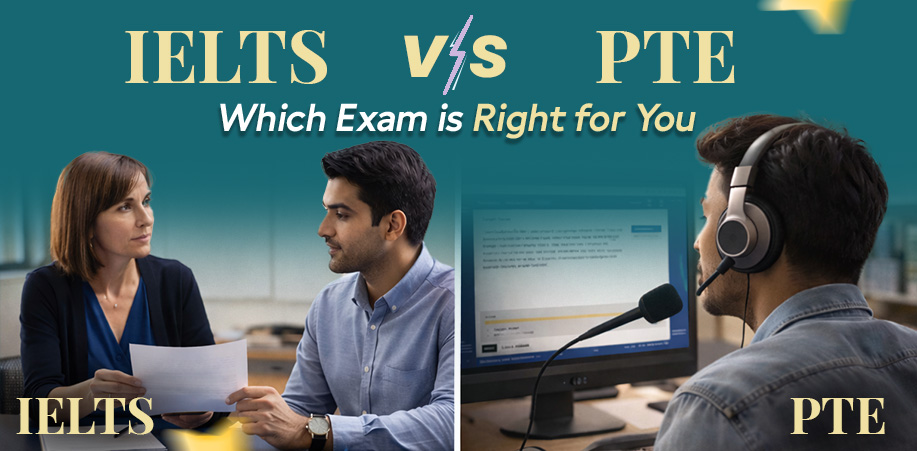
Choosing between English tests feels a bit like picking a path through a forest. Both lead to the same destination—your dream university or a new life abroad—but the journey on each path is very different.
The IELTS vs PTE debate is one of the most common topics in our student community. If you are feeling stressed about which one to book, take a deep breath. You aren’t alone. Today, we are going to strip away the complex jargon and look at the real “human” differences between these two giants.
By the end of this guide, you won’t just know the facts. You will know exactly which exam fits your personality, your computer skills, and your speaking style.
The Basics of the Big Two
Before we dive into the nitty-gritty, let’s define our players.
IELTS stands for the International English Language Testing System. It is the “grandfather” of English tests, managed by the British Council and IDP. It is known for its academic rigor and its face-to-face speaking component.
PTE stands for the Pearson Test of English. It is the “tech-savvy” younger sibling. It is entirely computer-based, from the reading section to the speaking tasks, and it is graded by an Artificial Intelligence (AI) algorithm.
When we look at IELTS vs PTE – Test differences, the first thing you notice is the “vibe.” One feels like a traditional school exam, while the other feels like a modern tech assessment.
IELTS and PTE – Exam pattern Breakdown
Understanding the IELTS and PTE – Exam pattern is the first step to success. While both tests evaluate Reading, Writing, Listening, and Speaking, the way they organize these skills is quite different.
The IELTS Structure
IELTS keeps things in neat boxes. You do your Listening, then your Reading, then your Writing. The Speaking test is often held on a different day or at a separate time in a quiet room with a real person.
- Listening: 30 minutes (plus 10 minutes transfer time for paper-based).
- Reading: 60 minutes.
- Writing: 60 minutes.
- Speaking: 11 to 14 minutes.
The PTE Structure
PTE is a faster, more integrated experience. It combines Speaking and Writing into one long session. Because it is computer-based, the whole test is finished in one go, usually in about two hours.
- Speaking and Writing: 54 to 67 minutes.
- Reading: 29 to 30 minutes.
- Listening: 30 to 43 minutes.
The “integrated” nature of PTE means that a single task might test two skills at once. For example, the “Read Aloud” task tests both your reading and your speaking. In the IELTS vs PTE comparison, this is a major factor. Some students find integrated tasks easier, while others prefer to focus on one skill at a time.
What No One Tells You About the Speaking Section
This is where the IELTS vs PTE choice usually becomes clear for most students. It all comes down to one question: Are you more comfortable talking to a human or a computer?
Speaking with a Human (IELTS)
In IELTS, you sit across from a certified examiner. They can nod, they can smile, and they can clarify a question if you didn’t quite catch it. For many, this feels natural. It’s a conversation. However, if you get nervous around “authority figures,” your palms might get sweaty.
Speaking to a Machine (PTE)
In PTE, you wear a headset and speak into a microphone in a room with other students. The AI doesn’t care if you look nervous. It only cares about your fluency and pronunciation. For some, this is a relief—no “judgmental” eyes. But for others, the “noise” of other students speaking at the same time can be very distracting.
Scoring Secrets and AI vs Human Markers
When comparing IELTS vs PTE – Test differences, we have to talk about how your work is graded.
IELTS uses a mix. Your Reading and Listening are often auto-graded, but your Writing and Speaking are marked by real human experts. This means if you write a very creative essay with deep emotional meaning, a human will “get” it.
PTE is 100% AI. The computer looks for specific patterns, keywords, and oral fluency. If you have a very strong, “thick” accent that the AI hasn’t been trained on, you might find it harder to get a high score. However, if you follow the PTE “templates” perfectly, the AI is very predictable.
Which Exam is “Easier” for Writing?
Writing is the “boss level” for most international students. In the IELTS vs PTE battle, the writing tasks require very different strategies.
IELTS Writing
You have two tasks. Task 1 is describing a chart or graph, and Task 2 is a 250-word essay. You need to show complex grammar and a wide vocabulary. The human markers are looking for a logical “flow” of ideas.
PTE Writing
You are often asked to summarize a text in a single sentence or write a short essay. Because a computer marks this, you can often use “templates” to ensure you hit the right keywords. Many students who struggle with creative writing find the “structured” nature of PTE writing much easier to handle.
Real World Acceptance and Recognition
You don’t want to pass an exam only to find out your university doesn’t accept it.
IELTS is the “Gold Standard.” It is accepted by over 12,000 organizations globally, including every single university in the UK, Australia, Canada, and New Zealand. If you are applying for a visa, IELTS is almost always the safest bet.
PTE is growing fast. It is widely accepted for Australian and New Zealand migration and by thousands of universities in the UK and USA. However, some specific professional bodies (like certain nursing or legal boards) still prefer IELTS. Always check your specific university requirements before booking!
The Technology Factor: Can You Type?
This is a “human” detail that many blogs forget.
If you choose IELTS vs PTE, you need to look at your hands.
- Are you a fast typer? If yes, PTE or IELTS on Computer will be great for you.
- Do you have messy handwriting? Avoid Paper-based IELTS at all costs!
- Do you struggle with technology? If using a computer for three hours straight sounds like a nightmare, the Paper-based IELTS is your best friend.
PTE requires a certain level of “computer literacy.” You need to be comfortable navigating screens and managing your time with a digital clock ticking in the corner of your eye.
Comparing the Costs and Results Speed
Let’s talk about your wallet and your schedule.
In terms of price, the IELTS vs PTE difference is usually small. In India, for example, both exams cost around 16,000 to 17,000 INR.
The real difference is speed.
- IELTS Results: Usually take 3 to 5 days for the computer version and 13 days for the paper version.
- PTE Results: Often arrive within 24 to 48 hours.
If your university deadline is in three days, PTE is your literal lifesaver.
IELTS One Skill Retake: The Game Changer
In 2026, IELTS introduced a massive advantage called the One Skill Retake.
Imagine you get a great score in Speaking, Reading, and Listening, but you fail the Writing section by half a band. In the past, you had to retake the entire test. With IELTS, you can now just retake that one section.
PTE currently does not offer this in most regions. If you fail one part of PTE, you usually have to pay for and sit the whole two-hour exam again. When choosing IELTS vs PTE, this “safety net” makes IELTS very attractive for students who are worried about one specific skill.
A Detailed Look at the Exam Modules
To truly understand the IELTS and PTE – Exam pattern, we need to look at the specific tasks. This is where you can decide which one “feels” right for your brain.
The Reading Challenge
IELTS reading involves long passages (often 700-900 words) with 40 questions. It requires deep concentration. PTE reading uses shorter texts but asks you to “reorder paragraphs” and “fill in the blanks.” If you have a short attention span, you might prefer the “snack-sized” tasks of PTE.
The Listening Test
In IELTS, the recordings are often social or academic conversations (like two people booking a hotel or a professor giving a lecture). In PTE, the recordings are almost exclusively from authentic academic sources. PTE listening also includes “Write from Dictation,” which tests your short-term memory as much as your English.
The “Eduget Global” Decision Matrix
Still can’t decide? Let’s use this simple checklist to settle the IELTS vs PTE debate for you.
Choose IELTS if:
- You prefer talking to a real person.
- You want the “One Skill Retake” safety net.
- You are applying to a very traditional or prestigious university.
- You want to use a pen and paper.
Choose PTE if:
- You are in a huge rush for results.
- You are very comfortable with computers and typing.
- You prefer “templates” over “creative writing.”
- You get intimidated by face-to-face interviews.
Preparing for Success: The Human Element
No matter which path you take in the IELTS vs PTE journey, the secret to a high score isn’t just “knowing English.” It is “knowing the test.”
At Eduget Global, we tell our students that these are strategy tests. You can be a native speaker and still fail if you don’t understand the IELTS and PTE – Exam pattern.
- For IELTS: Focus on your “Lexical Resource” (using fancy words correctly) and your “Task Response.”
- For PTE: Focus on your “Oral Fluency.” Don’t stop to correct your mistakes—just keep flowing so the AI thinks you are confident.
Common Myths Debunked
Let’s clear the air on some “fake news” circulating in student forums.
Myth 1: PTE is “easier” than IELTS.
The Truth: Neither is “easier.” PTE is more “hackable” with templates, but the AI is very strict about pronunciation. IELTS is more “traditional,” but the human examiners can be more flexible with accents.
Myth 2: Universities prefer IELTS.
The Truth: Ten years ago, yes. In 2026, most major universities in the UK, Australia, and Canada treat them exactly the same.
Myth 3: You can’t get a 9.0 (or 90) on your first try.
The Truth: Many of our students at Eduget Global hit their target on the first attempt because they focused on the specific IELTS vs PTE – Test differences and practiced the right skills.

How Academic Institutions View the Results
When an admissions officer looks at your sop document and your test scores, they are looking for “consistency.” If your SOP is written in perfect, complex English but your IELTS score is a 5.5, they will get suspicious.
In the IELTS vs PTE world, universities trust both because both are “secure.” Both use biometric data (like palm prints or face scans) to make sure you are the one taking the test. This security is why your score is so valuable.
Final Checklist Before You Book
Before you pay your hard-earned money for a test slot, do these three things:
- Take a Mock Test: Try one of each. Most students “feel” a preference within 20 minutes.
- Check Your Destination: Go to the university website and look for the “English Language Requirements” page.
- Check Your Hardware: If you choose PTE, make sure you practice with a headset. If you choose IELTS, practice writing on the specific answer sheets.
Summary: Your Path to Global Success
The IELTS vs PTE choice is a personal one. There is no “right” answer, only the “right for you” answer.
If you love the human touch, the flexibility of paper, and the security of a retake option, IELTS is your winner. If you love speed, technology, and a structured, computer-marked system, PTE is your best friend.
At Eduget Global, we are here to support you whichever path you take. We don’t just help you pass a test; we help you start a new chapter of your life. Whether it is mastering the IELTS and PTE – Exam pattern or perfecting your university application, your success is our mission.
Conclusion
We hope this deep dive into IELTS vs PTE – Test differences has given you the clarity you need. Choosing an exam shouldn’t be the hardest part of your journey—studying for it should be!
Now that you have the facts, pick your date, build your study plan, and get ready to show the world what you can do.
‘Tis the season to achieve your dreams and your English score that opens the door.


